
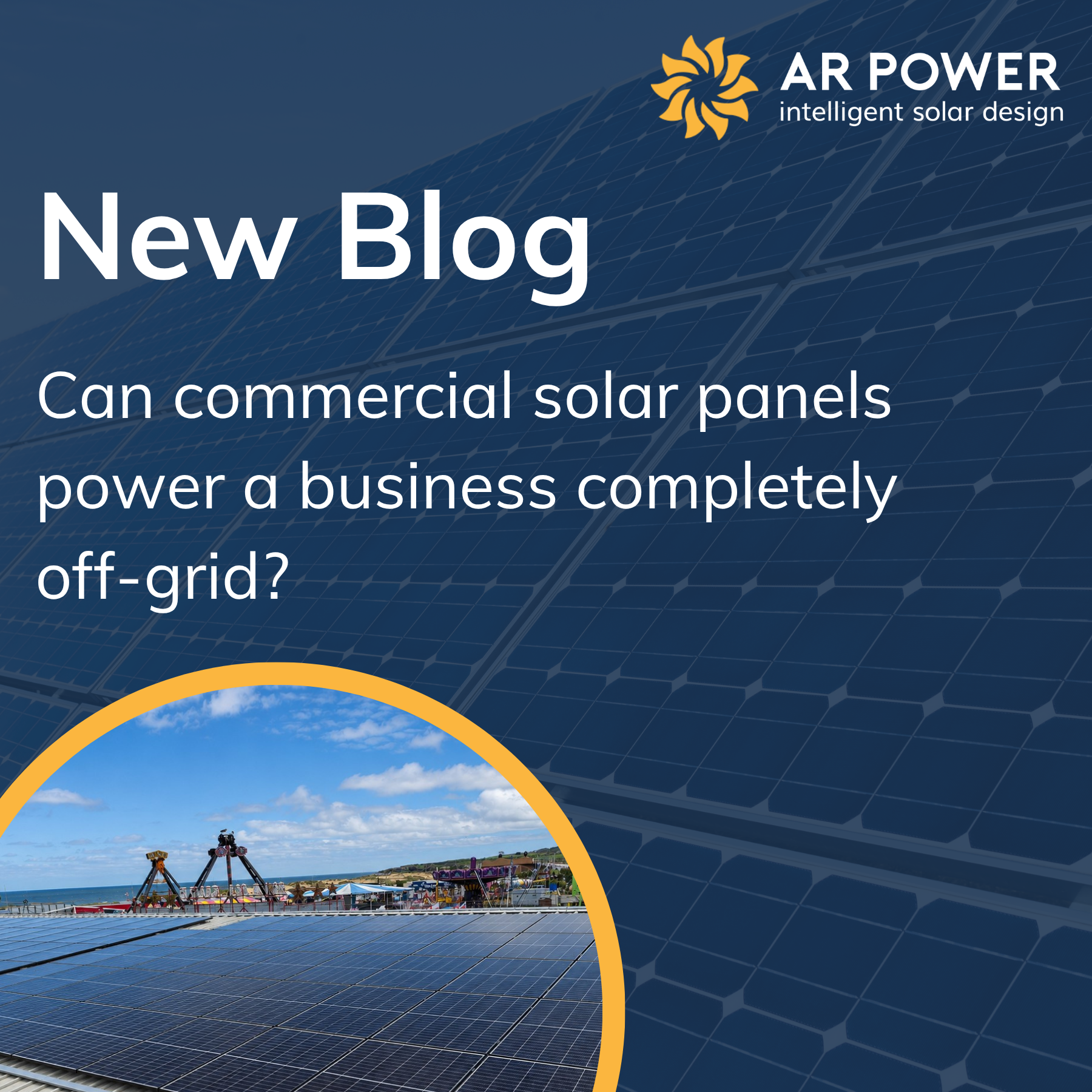
As energy costs continue to fluctuate and businesses look for greater control over their operating expenses, many organisations are asking the same question: Can commercial solar panels power a business completely off-grid?
In our latest blog, Technical Manager, Simon Lindsay, explains if moving your business completely off-grid is viable.
What does business energy independence mean?
Business energy independence doesn’t necessarily mean disconnecting entirely from the National Grid.
Instead, it refers to reducing reliance on external electricity suppliers by generating and managing more of your own power. For many organisations, this means installing commercial solar panels alongside battery storage to maximise the use of renewable energy throughout the day and night.
Achieving greater independence offers several advantages, including:
- Lower electricity bills
- Protection against volatile energy prices
- Reduced carbon emissions
- Improved business continuity during periods of high demand
- Greater control over long-term energy costs
For many businesses, the goal isn’t complete isolation from the grid, it’s reducing dependence on it as much as possible while maintaining reliable operations.
Can a commercial building run entirely on solar?
Technically, yes but only in the right circumstances.
Whether a commercial property can operate entirely from solar power depends on several key factors:
Energy consumption
A business with relatively low electricity usage will find it much easier to operate off-grid than one with heavy manufacturing equipment, refrigeration systems or machinery running around the clock.
Understanding your daily, weekly and seasonal electricity demand is the first step in determining whether off-grid commercial solar is a realistic option.
Available roof or land space
Solar panels need sufficient space to generate enough electricity.
Large warehouses, agricultural buildings and industrial units often have extensive roof areas, making them ideal candidates for commercial solar installations. Office buildings with smaller roofs may not be able to generate enough energy to meet all of their requirements. An example of our work can be found in a recent case study.
Seasonal weather
Solar generation naturally varies throughout the year.
During the summer months, commercial solar systems can often generate more electricity than a business uses during daylight hours. In winter, shorter days and reduced sunlight mean generation decreases significantly. In our recent blog, we looked at why winter planning is vital to gain maximum benefits during the summer months, you can read this here.
The role of solar battery storage for businesses
One of the biggest challenges with solar energy is that electricity isn’t always generated when it’s needed, this is where solar battery storage for businesses becomes essential.
Battery systems store excess electricity produced during sunny periods, allowing businesses to use that energy later in the day, overnight or during periods of poor weather.
Commercial battery storage offers several important benefits:
- Maximises self-consumption of solar energy
- Reduces reliance on electricity imported from the grid
- Helps manage peak electricity demand
- Provides backup power during outages (depending on system design)
- Improves return on investment from solar installations
Without battery storage, much of the electricity generated during the day may be exported to the grid while businesses continue buying electricity during the evening.
Combining commercial solar PV with battery storage creates a much more efficient and resilient energy solution.
Why staying connected to the grid still makes sense
Although complete business energy independence is possible for some specialist sites, remaining connected to the National Grid is usually the most practical and cost-effective solution. The grid acts as a safety net.
During periods of high electricity demand or prolonged poor weather, businesses can import additional electricity when needed. Equally, when solar panels generate surplus electricity, that excess energy can often be exported back to the grid.
This hybrid approach offers the best of both worlds:
- Significant reductions in electricity costs
- Greater resilience against rising energy prices
- Reliable power throughout the year
- Lower installation costs than fully off-grid systems
- Flexibility as your business grows
For most commercial properties, reducing reliance on the grid rather than eliminating it entirely delivers the strongest long-term value.
How businesses can reduce reliance on energy suppliers
Even if complete off-grid operation isn’t the objective, there are several ways businesses can dramatically improve their energy independence.
Install commercial solar panels
Generating renewable electricity on-site immediately reduces the amount of power purchased from suppliers.
Improve energy efficiency
LED lighting, efficient HVAC systems, smart controls and modern equipment all reduce electricity demand, making it easier for solar generation to cover a greater proportion of usage.
Plan for future growth
An experienced solar installer, such as AR Power, can design systems that can be expanded as your energy needs evolve, ensuring your investment continues to deliver value for years to come.
Businesses already improving their energy resilience
Across the UK, organisations in manufacturing, logistics, agriculture, retail and education are investing in renewable energy solutions to strengthen their energy security.
Warehouses with large roof spaces are generating significant amounts of electricity through commercial solar installations.
Manufacturing facilities are pairing solar PV with battery storage to reduce peak electricity costs.
Agricultural businesses are powering equipment and buildings using renewable energy generated on-site.
Schools and public sector organisations are lowering operating costs while supporting sustainability goals.
These organisations may not all operate completely off-grid, but they are significantly reducing their dependence on traditional energy suppliers while improving resilience against future price increases.
Is off-grid commercial solar right for your business?
Every business has different energy requirements, so there’s no one-size-fits-all answer, for most commercial properties, however, the most effective strategy is combining commercial solar panels with solar battery storage for businesses while maintaining a grid connection.
This approach provides greater business energy independence, lower operating costs, improved energy resilience and a more sustainable future without compromising reliability.
At AR Power, we design bespoke renewable energy solutions tailored to each organisation’s energy usage, budget and long-term objectives. Whether you’re looking to reduce electricity costs, improve sustainability or explore the potential of commercial battery storage, our experienced team can help you identify the right solution for your business.
Ready to explore solar PV for your business?
AR Power works with businesses to design and install commercial solar PV systems tailored to their energy requirements.
If you’re considering solar for your business, get in touch with the AR Power team to discuss your requirements and start planning for the year ahead.


